
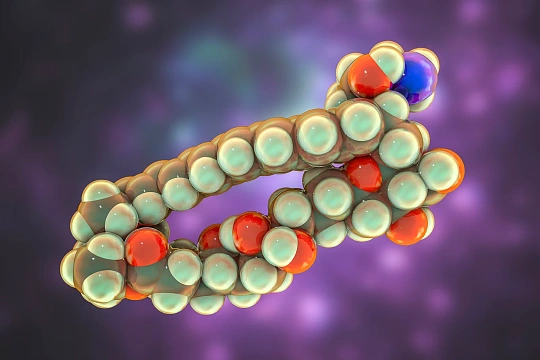
This is what is behind the surge in searches. There is no validated dose, and no trial has used this blend in anyone. What exists is arithmetic — and because of the fixed ratio, it deserves caution.
What trials used
There is no data on the blend. For individual components: the rat tendon study used intraperitoneal injection of 10 mcg/kg BPC-157 and 60 mcg/kg TB-500 daily for four weeks. The two-person BPC-157 pilot used IV single doses of 10 mg and 20 mg. All GHK-Cu human trials used cream formulations. None of this translates directly to a subcutaneous blend dose.
Reconstitution math
Start with the vial. At a 50/10/10 mg ratio, each component’s concentration depends on how much bacteriostatic water you add.
BAC water added Per 10 units (0.1 mL) Per 20 units (0.2 mL) Doses per vial at 20 units
2 mL 2.5 mg GHK-Cu · 500 mcg BPC-157 · 500 mcg TB-500 5 mg GHK-Cu, 1 mg each of the others 10
4 mL 1.25 mg GHK-Cu · 250 mcg BPC-157 · 250 mcg TB-500 2.5 mg GHK-Cu · 500 mcg each of the others 20
5 mL 1 mg GHK-Cu · 200 mcg BPC-157 · 200 mcg TB-500 2 mg GHK-Cu, 400 mcg each of the others 25
The fixed-ratio problem
Suppose you follow a BPC-157 user protocol of 250 mcg twice daily. At 4 mL, that is 10 units twice a day. Fine. But look at what comes with it.
Your TB-500 becomes 500 mcg daily — 3.5 mg per week, given daily, rather than the 2 to 2.5 mg twice weekly used in TB-500 protocols. Your GHK-Cu becomes 2.5 mg daily by injection, a compound that has only been tested in humans as a cream. That is roughly 0.4 mg of elemental copper entering the body subcutaneously every day.
Or reverse it. Suppose you inject 1 mg GHK-Cu daily, all the copper you need. That is 8 units from a 4 mL vial. Your BPC-157 dose drops to 200 mcg daily, below most protocols, and the “repair” portion of the vial is now a small fraction of your dose.
Whichever number you pick, you are choosing one peptide’s dose and accepting the inevitable dose of the other two. That is the fixed-ratio problem, and no dosing table solves it.
Handling notes
Treat the vial as a multi-dose sterile vial: discard 28 days after first puncture, and use a new needle for every draw. At 10 units daily from a 4 mL vial, a 70 mg vial lasts 40 days, so the discard date arrives before the powder runs out.
Conclusion
GLOW’s fixed ratio locks the only factor you can control — each peptide’s dose — to the supplier’s chosen proportions. Understanding this matters more than copying an online dosing table.