
What Do Peptides Actually Do in the Human Body? Four Roles: Signaling, Hormones, Immunity, and Structure
Overview
Peptides are short chains of amino acids that act as precise signals in the body. They can influence metabolism, recovery, and cellular function. Although research is still ongoing, current data (Kearly et al., NIH) indicate that peptides play a key role in growth, development, and stress responses.
This article explains the actual roles of peptides in the human body from four angles: signaling molecules, hormones, immune defense substances, and structural components.
1. Peptides as Signaling Molecules
Peptides act as potent signaling molecules, binding to specific target proteins or G protein-coupled receptors. This binding forms a complex that acts like a biological switch, turning cellular responses on or off.
The signal then activates other proteins, including G proteins and tyrosine kinases. This process regulates a wide range of functions in the body.
Evidence suggests (Han et al., National Institutes of Health) that these structures regulate complex immune and metabolic pathways.
Small-molecule drugs bridge the gap between high specificity and low cost. Small-molecule drugs have a very limited contact area, ranging between 300 and 1,000 square angstroms.
An angstrom is a very small unit used to measure distances at the atomic scale, equal to one ten-billionth of a meter. In chemistry, it is commonly used to describe distances between atoms or the length of chemical bonds. For example, a typical carbon-hydrogen bond is about 1 angstrom long.
Mathematically, it can be written as:
1 Å = 10⁻¹⁰ meters
Most atoms are about 1 to 2 angstroms in size. Therefore, the angstrom is a practical unit when studying molecular scales, avoiding lengthy decimal values such as meters or nanometers.
Protein interactions cover a much larger area, reaching 1,500 to 3,000 square angstroms. These short chains are larger than small-molecule drugs and therefore more flexible when binding to receptors. They also penetrate tissues more effectively than large protein molecules.
2. Peptide Hormones and Systemic Regulation
Hormonal activity is an important part of how peptides function in the body. These water-soluble molecules typically consist of 3 to 200 amino acids. They are produced in one part of the body but can reach distant tissues to exert their effects.
Their main role is to regulate growth and cell differentiation. Some peptides control important systemic functions.
For example, insulin is a peptide composed of 51 amino acids, made up of two chains connected by disulfide bonds. It regulates blood glucose levels and maintains metabolic balance.
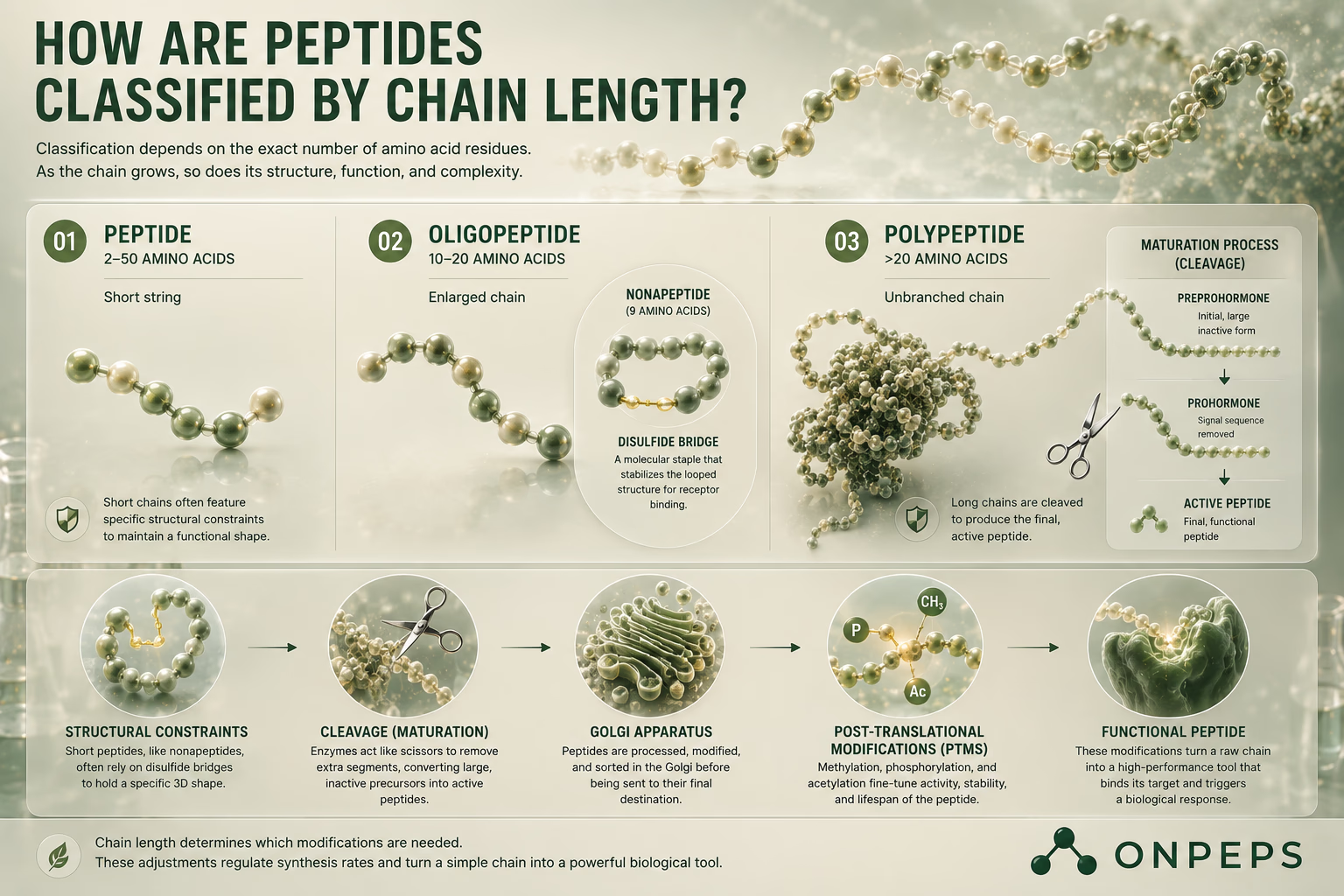
Oxytocin and antidiuretic hormone are both produced by the posterior pituitary. They are both nonapeptides containing a single disulfide bond, differing by only two amino acids. Neurophysin is a carrier protein responsible for transporting these peptide hormones in the body.
Secretin is another peptide hormone, composed of 27 amino acids. It stimulates the pancreas and bile ducts to release bicarbonate, helping to neutralize stomach acid.
Cardiac muscle cells release natriuretic peptides when the heart wall is under pressure, helping to regulate blood pressure.
Atrial natriuretic peptide is composed of 28 amino acids. Brain natriuretic peptide is composed of 32 amino acids. C-type natriuretic peptide is composed of 22 amino acids. These peptides share similar structures.
The diversity of these peptide hormones allows the body to precisely regulate metabolism and cardiovascular function. As research advances, we continue to explore the benefits of peptide hormones in humans and achieve new breakthroughs.
3. Antimicrobial Peptides: The Body's Built-In Rapid Defense System
A recent study (Zheng et al., National Institutes of Health) detailed how peptides defend against dangerous infections. They are an important part of the human immune system. Epithelial cells, neutrophils, mast cells, and adipocytes can all naturally produce peptides. They form a rapid and effective first line of biological defense.
Most of these defense molecules consist of 10 to 50 amino acids, carry a clear net positive charge, usually between 2 and 11, and contain a very high proportion of hydrophobic residues, often accounting for 50% of the total structure.
This special physical structure makes them highly aggressive. The positive charge allows them to interact electrostatically with invading bacteria. Bacterial cell walls carry a negative charge. These molecules attach to the bacteria and forcefully disrupt their lipid bilayer.
They carry out this disruption mainly in three ways:
The barrel-stave model forms a physical pore in the membrane.
The toroidal pore model causes the lipid layer to bend inward.
The carpet model coats the membrane until it completely breaks apart.
This allows them to kill invading microorganisms extremely rapidly. The entire process usually takes only 5 to 10 minutes. Mammalian cell membranes are completely electrically neutral. Therefore, these defense molecules do not attack or damage healthy human tissue.
4. Peptides as Structural Components and Metabolic Regulators
Beyond signaling, hormones, and immune defense, peptides also function as structural components and metabolic regulators.
They act as messengers, regulating hormones by binding to cellular receptors. This targeting ability makes them essential to life and to new drug development.
Peptides play a key role in metabolism, growth, and cell communication. Some peptides are used in medicine, particularly for treating metabolic diseases and cancer.
Their limitations include low oral absorption and rapid breakdown in the body. Their function and effects depend on their sequence, structure, and chemical modifications.
5. Summary
Peptides play four main roles in the human body:
First, as signaling molecules, they bind to receptors and turn cellular responses on or off.
Second, as peptide hormones, they regulate growth, metabolism, and cardiovascular function.
Third, as antimicrobial peptides, they form the body's rapid and effective first line of immune defense.
Fourth, as structural components and metabolic regulators, they participate in cell communication and new drug development.
Understanding these four roles helps provide a more complete picture of what peptides actually do in the human body — and why they have become such an important direction in modern medicine and drug development.
Frequently Asked Questions
What is the relationship between peptides and hormones?
Many hormones are themselves peptides, such as insulin, oxytocin, antidiuretic hormone, and secretin. They are made up of amino acid chains, are produced in one part of the body, and can reach distant tissues to exert their effects.
Do antimicrobial peptides harm human cells?
Usually not. Antimicrobial peptides carry a positive charge, while mammalian cell membranes are electrically neutral. Therefore, they mainly attack the negatively charged membranes of bacterial cells without damaging healthy human tissue.
Why is the oral absorption of peptide drugs low?
Peptides are easily broken down by enzymes in the digestive tract and have difficulty crossing the intestinal wall. As a result, oral absorption is usually low, and many peptide drugs need to be administered by injection.
Why are peptides more specific than small-molecule drugs?
Peptides have a larger contact area, reaching 1,500 to 3,000 square angstroms, compared with 300 to 1,000 square angstroms for small-molecule drugs. This gives them greater flexibility and specificity when binding to receptors.